

Who would have thought that you would come across a product made from polyamide if you have ever worn a pair of stretchy leggings, used a toothbrush or looked under the hood of a car? While it is one of the most frequent synthetic materials in the universe, most do not know its name. Polyamide has various trade names (nylon, Kevlar, Nomex) and is found in many locations. This article explains what polyamide is, how it is manufactured, the different varieties available and why industry is returning to it year after year.
What Is Polyamide
Basically, polyamide is a synthetic polymer, which is a long chain of repeating molecular units produced in a laboratory or factory. The prefix polymer is derived from the Greek word many, which is the prefix to polymer. The name of polyamide comes from the amide bonds that join these parts together (amide bonds are covalent bonds that join amino acids together in proteins). These amide bonds provide the strength and flexibility to the material.
Nylon is the most popular polyamide, which was discovered in 1935 by a DuPont chemist named Wallace Carothers. At the time, it was a big deal, as most fibers were natural such as cotton, wool or silk prior to nylon. Nylon was a viable cheap and stronger alternative which could be manufactured in bulk. It was first introduced as a substitute for silk for stockings and women were in a frenzy. Due to its remarkable strength and reliability, nylon was used for military products such as parachutes and ropes during World War II.
Since then there have been many other kinds of polyamides developed by chemists. Others are synthesized by condensing together small molecules in a process known as condensation polymerization. Others are made by opening up ring shaped molecules in a process called ring opening polymerization. The exact process will be determined by the properties required in the final material.
Types of Polyamide
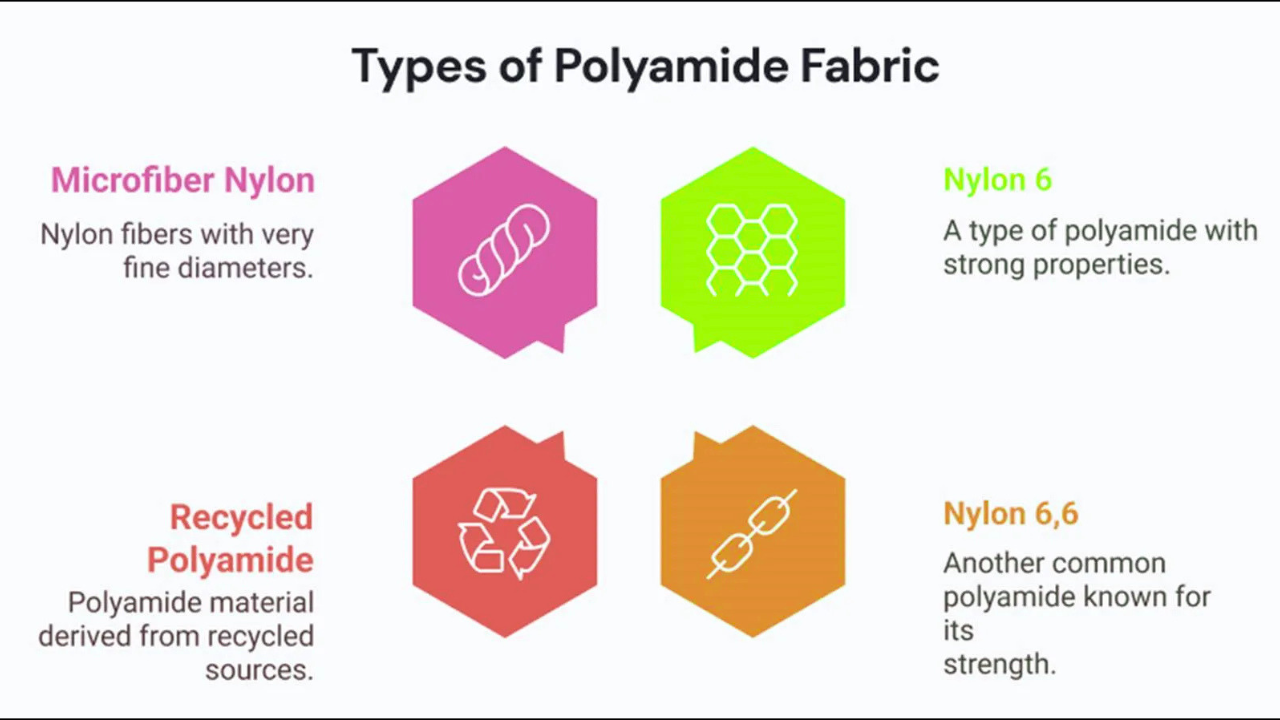
There are multiple different types of polyamides. The family has some members, each a strong part of the family.The most common types are nylon 6 and nylon 66. Nylon 6 is manufactured from one monomer (caprolactam) and Nylon 66 is produced from two monomers (hexamethylenediamine and adipic acid). The numbers in the name indicate the number of carbon atoms contained in each ingredient. Nylon 66 is a little more heat resistant and stiffer, and has higher moisture absorption and is somewhat stiffer when damp.
Another group are the aromatic polyamides. These can be manufactured of Kevlar, Nomex, and other materials. Aromatic polyamides, as opposed to nylon, have ring structures in the molecular chain. This makes them very strong and heat-resistant. Kevlar’s well-known use is in bulletproof vests, where it is used five times as heavily as steel for its strength per unit of weight. Nomex is commonly used in fire-resistant clothing and clothes worn by race car drivers.
Bio-based polyamides are new on the market. These are partially or entirely produced from renewable resources such as castor oil, rather than petroleum oil. They are attractive to businesses seeking to minimize the impact of their operations while maintaining the advantages of synthetic products.
Read Also: Nylon vs Polyester Fabric Showdown: Which Is Right for You?
Where You Will Find Polyamide
The range of use of polyamide is actually enormous. It’s impossible to miss it in the fabrics. Polyamide is used in sportswear, swimwear, hosiery and outdoor wear, and is used due to its stretch, abrasion resistance and fast drying time. It pairs well with other fabrics, such as cotton or spandex, and that’s why your gym clothes are so comfortable.
Polyamide is a workhorse in engineering and manufacturing. Engines, fuel lines, air intake manifolds and electrical connectors are among the many applications in which car manufacturers employ it. It can resist heat and vibration, important properties under the hood. It is a good electrical insulator, making it useful in electronics, including circuit board connectors, cable insulation, and the electronic componentry of a smartphone.
Applications are found in industry such as conveyor belts, ropes, nets and filters. It is also highly durable, even when subjected to heavy use, making it ideal for use in factories for long-lasting components. Polyamide is used in the medical industry for surgical sutures and certain kinds of catheters due to its strength and ability to be made extremely fine without fracturing.
For good reason, the use of aromatic polyamides such as Kevlar and Nomex in the aerospace and defense industries has been apparent to all. For applications where bullet resistance, flame resistance or high strength is required, polyamide comes to the rescue.
Advantages of Polyamide
Then why are so many industries still employing this material? There are a number of good arguments.
First, it’s very strong for its weight. That’s important for everything from clothing to car parts. Secondly, it is less prone to abrasion than many natural fibers. If you’re out hiking in rough terrain, you’ll likely find that your nylon jacket lasts longer than a cotton jacket. Thirdly, it is fairly heat resistant, particularly the aromatic varieties. Fourth, it can be easily shaped and formed when heated, and is manufactured easily. Fifth, it has resistance to many chemicals and oils; thus, this makes it a useful material in engines and industrial applications.
Polyamide is also compatible with other materials. It can be blended with natural fibers to combine the best of both textile worlds: softness and durability. It’s this versatility that makes it so relevant for almost 90 years.
The Downsides
There is no perfect material, and polyamide isn’t spared of issues. Environmental impact is the largest of the issues. The majority of polyamides are derived from fossil fuels. Costly and polluting to make. At the end of the product’s life, polyamide is not easily degradable in nature. Can remain in landfills for hundreds of years.
Recycling is possible, but challenging. Nylon is a recyclable material with decreasing quality with each cycle. There are chemical recycling processes that can regenerate the material into its constituents, but they are not commonly employed as yet and are costlier. Some companies are developing closed-loop systems where old fishing nets or carpets are recycled to make new nylon products, but these are a minority of the market.

Another problem is moisture absorption. The standard nylons absorb water and become swollen and loose, affecting their dimensions and mechanical properties. This is important for precision engineering applications, which require close tolerances. Polyamides that are aromatic such as Kevlar, have reduced moisture absorption but are more expensive.
UV degradation is an issue as well. Polyamide can degrade over time due to prolonged exposure to the sun, so it is often subject to additional coatings or treatments for outdoor use.
What will the future look like?
The polyamide industry is far from dormant. Several research projects are underway to improve the material and make it greener.
There is a rising interest in bio-based feedstocks. There are companies that have pioneered the development of polyamides using castor beans and other plant materials, such as Arkema and BASF. These decrease the need for oil and reduce production’s carbon footprint. They are not a panacea but they represent a good start.
New technology for recycling is emerging. The development of new chemical recycling technologies makes it possible to recover pure polyamide raw material without degradation. If these can be made more affordable on a large scale, a circular economy for nylon products may become a reality.
Enhancements to the performance are also ongoing. Nanotechnology is being employed to enhance properties such as antibacterial surface, resistance to UV and flame retardancy. The adjustments bring new possibilities in fields like health care, aerospace and consumer goods.
Some researchers even want to develop self-healing polyamides that will repair small cracks on their own. This may prolong the useful life of products, and in the long term less waste.
Final Word
One of these materials that quietly runs the modern world is called polyamide. One among these materials is polyamide. It’s in your clothes, car, electronics and sometimes even in your body. This family of materials has stood the test of time, from nylon stockings in the 30’s to bulletproof vests today.
Is not infallible. The environmental cost is very real and industry must continue to strive for improved recycling and “green” production. The versatility, strength and reliability of polyamide, however, is slated for no end of life. If you are a fabric selector, an engineer, or simply someone who wants to know what the fabric in their clothing is, it’s useful to learn about polyamide.
Read More: Fashionlamb com Review: Is This Fashion Website Legit?
