

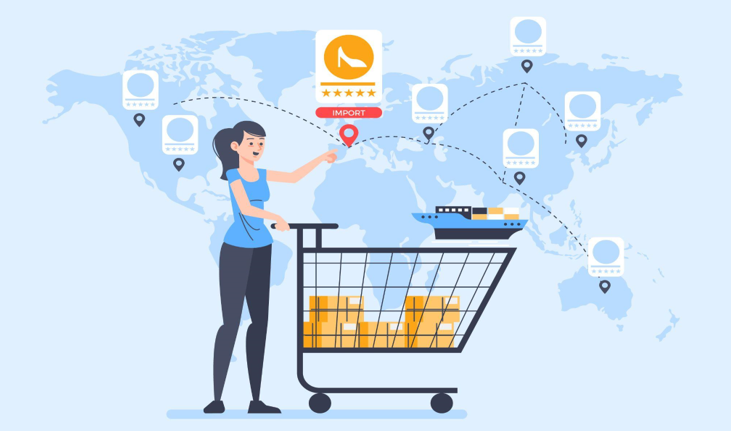
The e-commerce scenario worldwide has provided an unprecedented opportunity for Indian entrepreneurs to expand their business globally. While exporting products from India via Amazon Global Selling, you are essentially not only shipping your products but also developing a sustainable export business. Today, with the extensive reach of the Amazon ecosystem, the 18+ marketplaces, and its reach to hundreds of millions of customers, the concept of exporting your products from India can never be more lucrative. This detailed guide would teach you how to develop your export business through Amazon.
Understanding the Advantage
However, before delving into the tactical steps, let’s first understand what ultimately made Amazon the preferred platform for Indian exporters looking to export from India. From online seller registration and compliance to logistics and payment support, it helps exporters at every stage, including first-time exporters, solve international trade challenges. Since 2015, the platform has enabled cumulative e-commerce exports of over $20 billion from India and has helped Indian sellers dispatch more than 750 million units globally. The proof from its successful track record is that if you export a product from India through Amazon, you are powering a system designed for success.
1. Target Marketplace Selection
The initial step for your export venture will be the selection of where to market your product. Amazon is present through marketplaces catering to different continents such as North America, Europe, the Middle East, and Asia Pacific.
● North American Markets:
The biggest market with a large number of customers and strong purchasing power exists in the USA, Canada, and Mexico. The USA market values products that are handmade, home textiles, and genuine ethnic products from India.
● European Markets:
The demand for Indian clothing, cosmetics, and ayurvedic products is considerable in the UK, Germany, France, Italy, and Spain. The European market is very environment- and authentic-oriented, a fact that the Indian market naturally possesses.
● Middle Eastern Markets:
UAE and Saudi Arabia: These countries provide increasing opportunities for ethnic wear, spices, jewelry, and home decor. Their culture provides familiarity with export products from India.
● Asia-Pacific Region:
There is growing demand from the Japan, Australia, and Singapore markets for Indian tea, spices, yoga products, and wellness products. Begin with one or two marketplaces to test your market before optimizing your processes for further geographical area expansion.
2. Essential Documents:
● Importer Exporter Code (IEC):
It is a 10-digit code assigned to exporters by the Directorate General of Foreign Trade (DGFT), which is mandatory for all exporters. It helps the exporter claim export incentives, as well as GST exemption, on the exports.
● Authorised Dealer (AD) Code:
It is obtained from the bank and has 14 digits; it helps in worldwide deals and foreign exchange compliance.
● Letter of Undertaking (LUT):
Submission of an annual LUT on the GST portal facilitates the export of products from India without paying the Integrated GST, which is a huge boost to cash flow.
● Importer of Record (IOR):
For some destination countries, you will be required to have an organization that acts as your customs compliance and duty-paying concern in the destination country.
● Product/Specific Licenses:
Based on the type of products, whether food, electronic, or cosmetic, there may be specific licenses required in the case of the target countries, in addition to the licenses.
Amazon’s Export Navigator puts you in contact with the service providers that can be of assistance in an efficient manner, thereby making it easy for the exporters.
3. Creating Your Amazon Seller Account
It takes about 15 minutes to register, and this only calls for minimal documentation that may include ID proof, address proof, and a debit/credit card that supports global transactions.
Select your main marketplace when you register, and then remember that you can add more marketplaces later using the same login information. Having a central seller dashboard makes it easy for you to handle more than one overseas storefront.
4. Optimizing Product Listings for Global Customers
The creation of attractive product listings is very important for exporting your product from India, since the buyers are not in a position to see the product before buying it online.
● Product Title Optimization
Add relevant keywords that international buyers search for when looking for the product. Research the search terms buyers use in the market in which the product will be sold.
● High Quality Images:
These should be provided for different angles of the product and should demonstrate how it is used, along with Amazon’s technical requirements being met for Amazon selling.
● Product Description in Detail:
You should provide a detailed description to attract more customers and to show that the product is different from those of the competitors.
● Backend Keywords:
Use all the keyword fields on the backend with appropriate search terms.
● Pricing Strategy:
Research competitor pricing within the target marketplace. Consider factors such as shipping, marketplace fees, customs duties, and intended profit margin when determining pricing.
5. Choosing Your Fulfillment Method
Amazon provides two main fulfilment options while exporting goods originating from India:
● Fulfillment by Amazon (FBA):
You can ship your merchandise to the Amazon fulfillment centers in your desired market. Amazon would take care of the storage, boxing, shipping, customer service, and returns. Your products would now be eligible for shipping on Prime, leading to much better visibility and sales. “Amazon Global Selling (SEND)” is a program with affordable shipping from India to the United States’ Amazon fulfillment centers.
● Merchant Fulfilled Network (MFN):
They take care of the storing, packaging, and shipping. They have more control over the stock, but when targeting the less- popular markets, they can be cheaper. However, they need international logistics networks. A large number of the most successful exporting businesses utilize FBA because it offers them the convenience and perks associated with being a Prime business, despite the extra costs incurred
6. Managing International Logistics
● International logistics
Proper management of logistics is essential when exporting products from India. The following are some factors to be considered:
● Shipping Options:
Air freight is faster and more expensive. Sea freight is economical for larger shipments. These options can be used depending on the type of goods and customer expectations.
● Customs Clearance:
Make sure that all customs paperwork is accurate and complete. Amazon’s network of service providers has customs brokers to make this easier.
● Packaging Standards:
When packing items internationally, you need sturdy packaging if you are shipping over a long distance. Follow the country of destination’s packing rules, specifically if you are packing restricted items.
● Tracking & Communication:
Give your customers accurate information about where their packages are.
Conclusion
A successful global business through the export of your products from India using this facility is a highly optimised, finely tuned process. With this step-by-step approach, from the selection of the marketplace, the necessary documentation through listing optimisation, order fulfilment, and after-sales support, you can successfully build a global export business. There is massive potential offered through the combination of the integrated infrastructure offered by Amazon, the manufacturing base, skills, and entrepreneurial drive from India. Begin your global export business today, and join the list of forty thousand+ Indian Entrepreneurs who have successfully started global export businesses through Amazon.
